Православное христианство.ru. Каталог православных ресурсов сети интернет
Top.Mail.Ru

20/11/2025

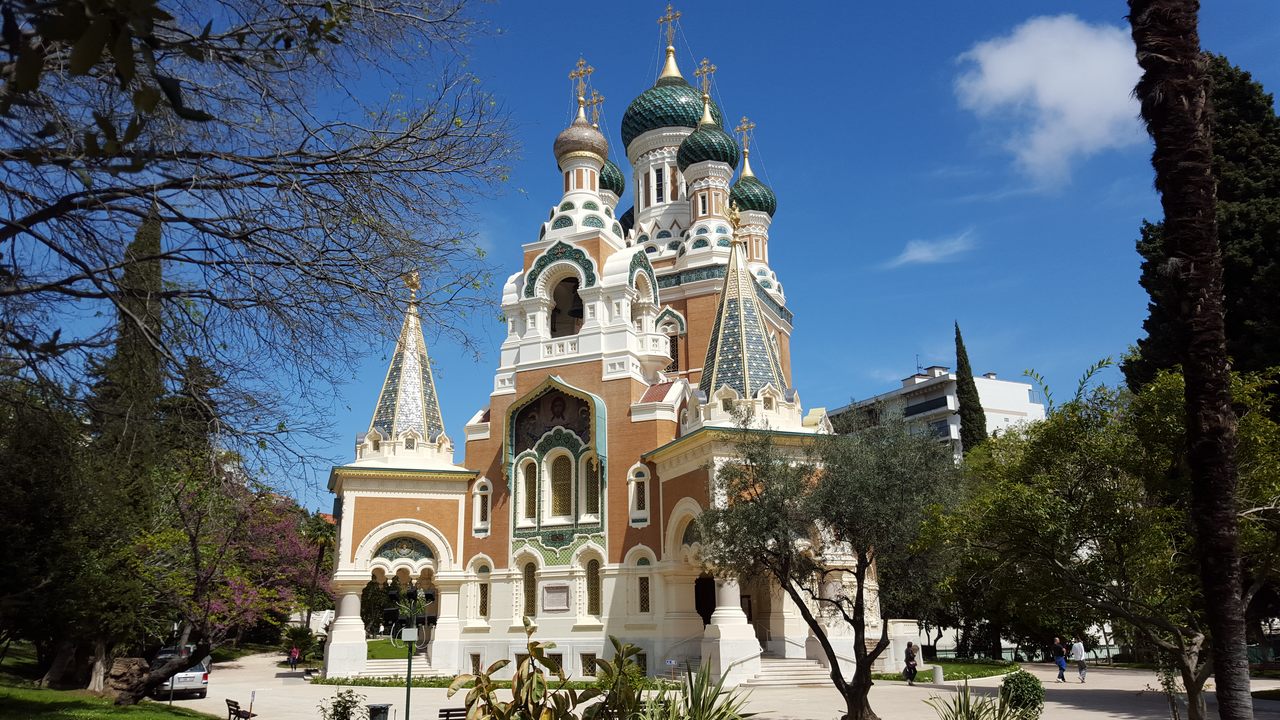
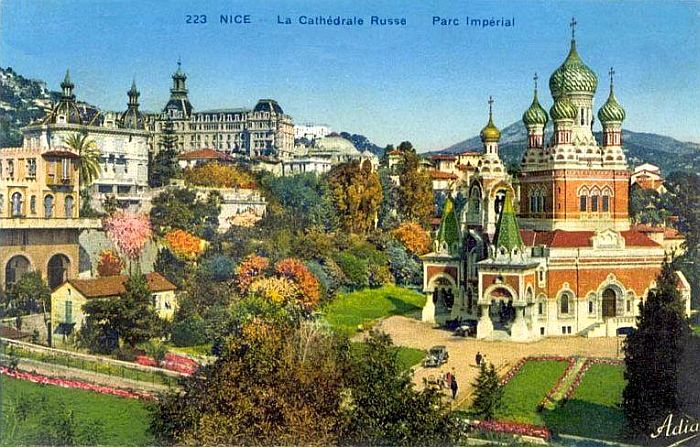
Saint-Nicholas Cathedral in Nice (1912).
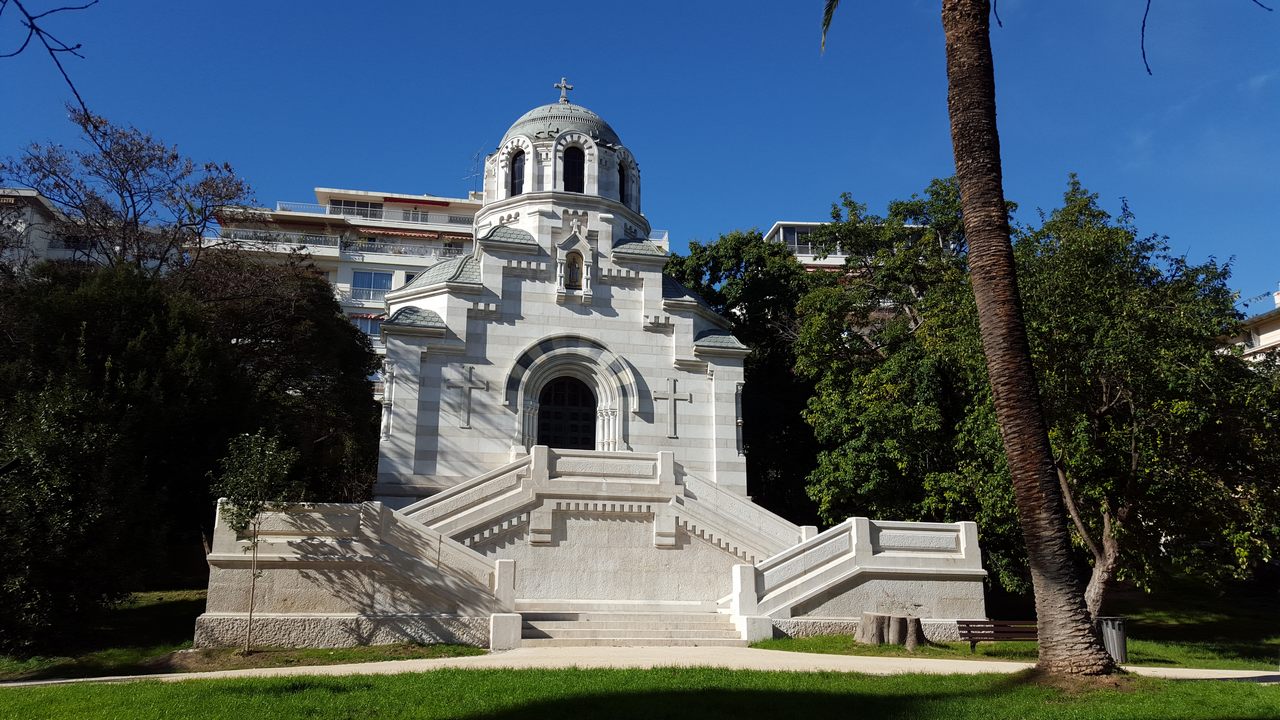
The memorial chapel of the Grand Duke Nicholas Alexandrovich (1865).

The church of St. Nicholas the Wonderworker in Nice is a precious gem in the treasure-trove of Russian church architecture of the beginning of the twentieth century. It is in every sense an extraordinary work not only for the Russian abroad, but within Russia itself it may without exaggeration be compared to St. Basil’s Cathedral on Red Square or the Church of the Saviour-on-the-Blood in St. Petersburg.

Villa Bermond and the inception of ‘Russian winters’ in Nice

There were good reasons for a church to appear in provincial and remote from the capital Nice. In 1853 between Russia and a coalition of countries (Great Britain, France, the Ottoman Empire, the Kingdom of Sardinia, which then came under Nice’s jurisdiction) the Crimean War had broken out. The Emperor Nicholas I resolved to help the Orthodox peoples living on the Balkan Peninsula in their struggle for liberation from the Turkish-Ottoman yoke. The outcome of this war was the signing under emperor Alexander II in 1856 of the Treaty of Paris which would demilitarize the Black Sea. The emperor’s brother Constantine – an admiral of the Russian navy – was entrusted with the task of coming to an arrangement with the King of Sardinia on relocating the Russian Black Sea flotilla from Sebastopol in the Crimea to Villefranche, the nearest suburb of Nice. In this same year on 26th October there arrived in Nice the mother of Alexander II – the widowed empress Alexandra Feodorovna and the widow of the emperor’s brother grand duchess Helene Pavlovna. The Empress met the King of Sardinia Victor Emmanuel II and the issue was resolved to the satisfaction of all: the Russian navy would be able to rent the port of Villefranche and Nice would enjoy the status of a resort for the aristocracy. The Empress would take for herself the Avigdor villa with a view of the sea, where she would construct the first Orthodox chapel in Nice. For the half-sibling Helen there would be the magnificent Bermond villa with its eucalyptus grove, orange orchards and fountains. The latter became a place of recreation, entertainment and festive receptions for two generations of the Russian imperial family. It is on its territory that our church is located.

Grand duke Nicholas' memorial chapel.

This place was overshadowed by tragedy in 1865 when Alexander II eldest son Nicholas was brought her to the Bermond villa for medical treatment. The young heir and grand duke died in the arms of his inconsolable mother and his father who soon arrived from St. Petersburg, having celebrated Easter there on 24th April. All of Nice accompanied him on his final journey on the Russian frigate Alexander Nevsky, which brought his remains to the Peter and Paul Fortress, the imperial burial vault of the Romanovs. The Emperor decreed that the villa’s large parcel of land be purchased, the house where Nixa (as he was affectionally called by his family) died be demolished and in its place a memorial chapel be built. The architect was the Petersburg academician David Grimm, who designed a chapel in the Byzantine style, an exact replica of the one in Chersonesus in Sebastopol, where he had built a cathedral on the site of the baptism of Prince Vladimir, founder of the state of Russia in the Xth century.

The chapel was built and consecrated in 1868 in the presence of the deceased’s brother the future Emperor Alexander III. Inside the chapel along its perimeter, there is a marble iconostasis with twenty-two icons by the court artist Timothy (Carl Timoleon) von Neff. One of the icons – of Christ’s resurrection – was commissioned personally by the Tsar and Tsarina. On the floor made of Carrara marble there is a black and white oblong marking out the place where the Tsarevich reposed. The empress Maria Alexandrovna donated a memorial covering with the initials of her son and three dates (of his birth, name’s day and day that he died), which is now kept in the cathedral, and also left there as a memorial to him an icon of St. Nicholas the Wonderworker. The mayoral office of Nice immortalized this part of Russian history by naming the street next to the villa ‘Boulevard du Cezaréwitch’, now simply known as ‘Tzaréwitch.’

Memory of the Tsar-Liberator Alexander II

The associations of the Bermond villa with Emperor Alexander II do not end there. The tsar liberated from centuries-old Turkish oppression the fraternal nation of the Bulgarians in the war of 1877-78, simultaneously extending the territory of Serbia, Montenegro and Romania. He annexed to Russia Central Asia and the Northern Caucasus. Within Russia herself he enacted the ‘great reforms’, part of which was the abolition of slavery in the form of serfdom. A year before his tragic death at the hands of the terrorist organization the ‘People’s Will’ on 1/13th March 1881, the tsar secretly wed his second wife the duchess Catherine Dolgorukova, who then received the new title of ‘Princess Yurievsky Serenissime.’ The Tsar’s death compelled her to leave the Winter Palace and settle in Nice with their three children. Before her death in 1922 she donated the Emperor’s personal effects – his favourite hussar’s uniform and blood-stained shirt – to the St. Nicholas Cathedral where they are kept to this day. Indeed, the people at the cathedral from its very beginning have revered the memory of the place’s founder; for example, in 1912 a large icon of St. Alexander Nevsky, the heavenly patron of the Tsar-Liberator, was installed in the cathedral.

The first Russian church in Nice.

For all of the significance of the Bermond villa and its memorial mausoleum to the Tsarevich, the spiritual life of Orthodox Christians of the Côte d’Azur centred around the small and unusual to the Russian eye church located near the old city. Opened in January 1860, it bore all the hallmarks of imperial grandeur. The luxuriant carved iconostasis – a gift from the empress mother – was complimented by old icons and expensive church plate. Of particular value was the library founded by Alexander Pushkin’s friend the poet Peter Vyazemsky who once wintered here. The church was the project of the widow of Emperor Nicholas I Alexandra Feodorovna, who was, like so many spouses of the Russian tsars, of German blood and for whom Orthodoxy became their main faith after once being Lutherans. Following the long-established custom, the new church was named after its main builders: the church in Nice was dedicated to St. Nicholas the Wonderworker in memory of the reposed Nicholas I and the holy martyr Alexandra, the heavenly protectress of the elderly Empress. We should not neglect to mention too that at that time Orthodoxy was the state religion of the Russian Empire and that the most important events in peoples’ lives were connected to the Church: it was the Church that baptized children and issued birth and marriage certificates; it was the Church which brought people together in marriage and accorded them the rights of a married couple; it was the Church which accompanied people on their final journey into eternity and ensured that offspring enjoyed rights as heirs. Abroad, the Church partially fulfilled the functions of the state, while priests received a salary and awards for their ministry and would be included in the Table of Ranks.[1] It was here in the church on Rue Longchamp that the heir to the Russian throne was first proclaimed the future Tsar Alexander III, who with his father attended the funeral of his older brother. It was here in Nice that he first met his future wife the Danish princess Dagmar, who mourned with him the loss of her first groom the young Russian Tsarevich … Who could then have imagined that divine providence would determine that she would not only outlive her husband but also her son, grandchildren and even the Russia she knew and later reminisce about?

Saint Nicholas Cathedral.

Thirty-five years later, during the reign of her son Nicholas II, the princess Dagmar, by now the widowed Empress Maria Feodorovna, now found herself once more on the shores of the Ligurian Sea. On vacation with her son the grand-duke George in the foothills of the Alps in ancient La Turbie (the site of the exploits of the Roman legionaries of Caesar Augustus), she met in 1896 the local priest Fr. Serge Lubimov and his well-to-do parishioners.[2] They complained of the narrowness of the small Russian church, which had also suffered from the recent earthquake in 1887. The church always closed down for the summer season. At the same time, the number of Russian families living in the environs of Nice would swell to several thousand during the winter and spring. Frequent visitors were members of the imperial family, those close to the imperial court and even… revolutionaries! One could travel there within three days on the newly-opened in 1864 St. Petersburg – Nice direct railway. It was impossible to enter the overcrowded church at Christmas and Easter. It was painful for Maria Feodorovna to recall the tragic days of her youth in Nice, and she would visit the city unwillingly. But she had to respond to their petition and she did all that was within her power to ensure that a new church would come into being.

The Emperor’s Gift.

The project was approved by Nicholas II, and in charge of it, at Maria Feodorovna’s recommendation, was the Emperor Nicholas I grandson Eugen Maximilianovich Romanovsky, duke of Leuchtenberg. Thus, the construction was from its very beginning done under the auspices of the Russian state and the patronage of the Imperial Family.

It was initially proposed that the existing church on Rue Longchamp be pulled down partly or fully and in its place there should be erected a grand building in the classical Russian style. The then construction limitations, however, obliged the construction committee formed in 1900 to initiate a search for another suitable place at the junction of what was then the deserted Streets of Verdi and Rivoli (now Rue Berlioz) in the ‘composers’ quarter’ not far from the railway station. The Holy Synod of the Russian Orthodox Church had prepared and approved a remarkable design for this plot of land by the architect-academician Michael Preobrazhénsky, but it never came to fruition. The ground beneath was too swampy and moreover the parishioners were not keen on the site as the backyard of a hotel. The plot of land could not be sold and there were no means of acquiring a new one.

It was then that the Emperor helped out. Duke Románovsky petitioned Nicholas II to build upon the crown lands of the former Bermond villa where there already was a chapel known at the time as the ‘Imperial Mausoleum’ (although there had never been any interment on the locality, nor could there ever be).

A solemn prayer service for the laying of the foundation stone for the St. Nicholas Cathedral was performed on the anniversary of the Tsarevich’s death on April 25th, 1903. The Romanov imperial family was represented by the grand dukes the brother of Alexander II Michael Nikolaevich (+1900, Cannes) with his children Michael (+1929) and Anastasia (+1922, Èze near Nice), the daughter of Alexander II Maria of Saxe-Coburg and Gotha (+1912) and of course the head of the construction committee duke George Románovsky (+1912). Aside from these notable persons, foundation stones for the cathedral were lain by the military governor of Nice, the mayor of the city Honoré Sauvain, duke Ferdinand the future tsar of Bulgaria (+1948) and many other Orthodox faithful. The Emperor sent a telegram: “I rejoice in my heart that I was able to grant to the Russian inhabitants of Nice a possibility to raise a new church. Nicholas II.” 

The construction works.

The construction of the church went apace with interruptions for nine long years, during which there were changes in contractors and committee chairmen, and during which Russia lived through the disastrous Russian-Japanese War and the first equally disastrous 1905 Revolution.

Upon the foundation of reinforced concrete there was installed a four-sided construction of worked stone blocks facing, according to Orthodox tradition, the east. The upper part of the church and the bell-tower for convenience and the fortification of the building were also made of reinforced concrete, which at the time was a great innovation. According to the original plan, which was not used for the new location, the church was supposed to have two separate entrances, each facing its own street) guarded by two monumental tent-like towers in the style of medieval Moscovia. The large window openings, untypical for of Russian architecture, would allow in plenteous light from the southern sun inside the hallowed walls. The whole construction was rounded off by five imposing domes typical of the cathedral style, with the central dome reaching a height of fifty-two metres.

In spite of its immense weight and grandeur, the church nonetheless creates an impression of lightness and of being dissolved into the ether. This effect was achieved not only by the exquisite nature of the shapes but also by the fact that each of the decorative elements had been carefully thought through. A lightness and pristine white were added by the marble-like matt stone from Lens processed by Italian craftsmen from drawings by Preobrazhénsky. The festive nature of the church was enhanced by the contrasting red brick from Germany and especially the glazed tiles made in Florence. The perfection of the ensemble and meaning was expressed through the massive gold crosses and in the mosaic panel of the image of the Saviour ‘Not-Made-By-Hands’ expertly executed in the Russian art-déco style. The mosaics were made under the direction of the great craftsman Vladimir A. Frolov, who had decorated the church of the Saviour-on-the-Blood in St. Petersburg where Tsar Alexander II had been murdered and who later in the Soviet period worked on the Lenin mausoleum and the Mayakovskaya and Avtozavodskaya stations of the Moscow underground.

Above the stone steps are the six-winged cherubim, their severe gaze exhorting those entering the church to leave behind all worldly thoughts. The combination of monumentality and refinement and a bright palette of colours creates an overwhelming impression and elevates the visitor into contemplating the divine deep structure of the beauty of the created world.

Interior decoration.

The external riot of colours, uniting into a single whole the deep blue of the southern sky, the emerald green of the domes and the exhilarating oxygen of the park’s atmosphere are instantaneously transformed by the restrained colour shades and prayerful concentration as one enters the church. The three-tiered iconostasis, covered with dimpled metal sheets of fiery gold, towers above us like a mystical tree of paradise, extending its branches with images of the saints and lifting up on high our gaze towards that which it conceals, the holy of holies of the heavenly Jerusalem. The rich accumulation of icons, reliquaries and church plate adds to the impression of an ark-like church in which the sacred objects of an empire now vanished for all eternity – Holy Russia – have found their salvation.

The iconostasis was executed by the Moscow court studio of the Khlebnikov brothers, and its icons were painted in the style of Palekh by the artist Leonid A. Pianovsky, who later collaborated with the great architect Alexey Schusev, author of the little but marvelous chapel in the Russian cemetery in Nice. Neither of them ever signed their work as this was the venerable tradition of Russian religious art: all things for the glory of God alone!

Its interior décor, however, was far from ideal. There was not enough funding or time for the frescos before the outbreak of the First World War. This is why a simplified decorative option was entrusted to De Signori, a young local artist of Italian origin who was not familiar with the basics of academic iconography and who worked under the guidance of Pianovsky. The colour spectrum of the interior was also unusual for Russian churches. The construction of the central chandelier was also left unattended. Unfortunately, the Russian emigration did not have the creative resources to complete the architectural ensemble, which remained a monument of the pre-Revolutionary period.

Nonetheless, the parishioners donated their family relics in order to maintain the adornment of the church as best they could. Even the sister of Emperor Nicholas II the grand duchess Xenia Alexandrovna lent a helping hand in the church’s decoration and donated to it in 1930 the Donskaya icon of the Mother of God which had been sewn with her own hand.

Final works, consecration and handing over to the church administration.

The church was equipped with the latest technology available at the beginning of the twentieth century: the metal tubes concealed electrical wires, electric light was used in the lamps of the iconostasis and large candlestands, the domes had copper lightning conductors, there was central water heating inside and a telephone connecting the sanctuary with the choir stall. And the parishioners in those days used not only carriages with coachmen but also came to church using modern-means of transport such as cars, motorbikes and the tram stop on nearby Boulevard du Tzaréwitch.

By 1910 the external work and the interior décor had been completed. All of this cost 1,2 million gold francs, of which 700 thousand were allocated from the exchequer of Emperor Nicholas II and 350 thousand by courtier and a son of a Russian ambassador to France, the third and last chairman of the Construction committee prince Serge Mikhailovich Galitzine (+1915, Lausanne).

A year earlier Emperor Nicholas II signed a decree on the free-of-charge transfer of the church building and its adjacent territory to the Russian Orthodox Church under synodal administration for a period of 99 years with the option of subsequent renewal of the emphyteusis lease. This was connected to the idea that the land upon which the church was built was acquired as far back as 1865 on the means of Emperor Alexander II and was left as an inheritance to each subsequent monarch. In 1909 this plot of land of 10 thousand square metres was transferred to the Office of His Imperial Majesty and then came under the administration of the Holy Synod of the Russian Orthodox Church, which then acquired with it additional property, to wit: a plot of land gifted to the Church by monsieur Gay on the east side of the church (Avenue Gay) measuring 950 square metres, part of which was transferred to the city for the building of a broad approach towards the church, which was then given the name of Avenue Nicolas II.

In December 1912 the Holy Synod dispatched from Moscow to Nice for the consecration of the church the bishop Triphon of Dmitrov and part of the male synodal choir. The Imperial House was represented by the duke of Leuchtenberg Alexander Georgievich Romanovsky, son of the first chairman of the Construction committee and grand duchess Maria Alexandrovna. The august guests, including the mayor of Nice general Goiran, were welcomed by prince Galitzine and archpriest Serge Lubimov (+1918), the rector of the church in Nice from 1888.[3]

By virtue of the church’s special significance for the Imperial Family and all Russians, the Holy Synod issued a decree granting it the unique status for Russian churches abroad of ‘cathedral’, a status which was not enjoyed even by the Embassy church dedicated to St. Alexander Nevsky in Paris. The church was recognized as the most outstanding example of the ‘Russian style’ abroad through its combination of traditional Russian architecture (in this instance that of Moscow and Yaroslavl at the turn of the seventeenth century) and ultra-modern art-déco. This was the style preferred by the last two Russian tsars. The church was considered to be the most beautiful among the Russian emigration.

Archpriest Andrey Eliseev,
Rector of the Cathedral


[1] A formal list of ranks and positions in the government, court and administration of Imperial Russia, introduced by Emperor Peter I the Great.

[3] Archpriest Sergy G. Lubimov, The Russian Orthodox church in Nice and its establishments, Saint-Petersburg, 1900, p. 4.